Tick Repellents: How to Choose and Use Them Safely
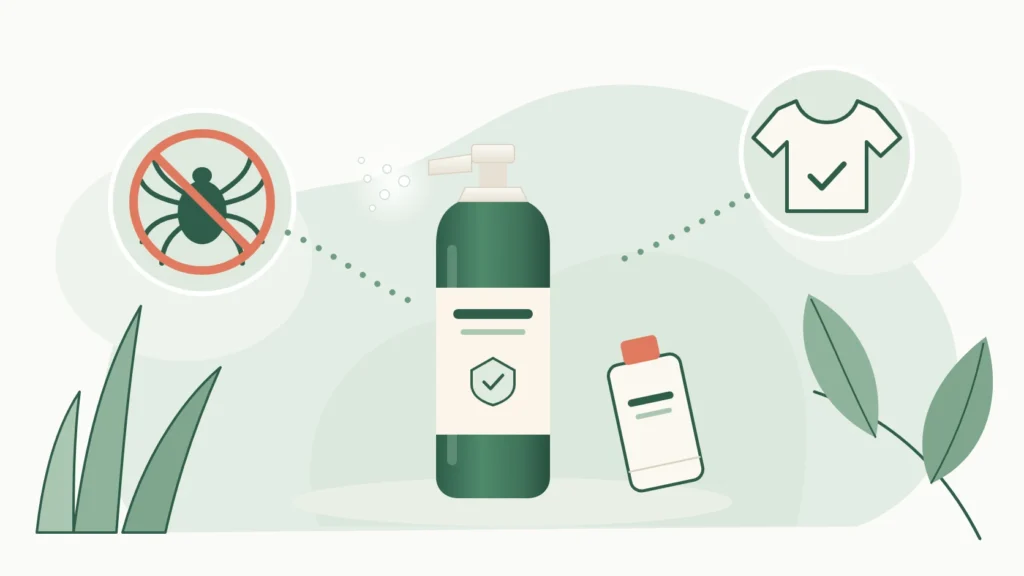
The right repellent, used the right way, is one of the simplest ways to protect yourself and your family from tick bites. Here’s how to compare repellent ingredients, treat clothing with permethrin, and use repellents safely on adults and children.
Medical Disclaimer
LymeSearch provides educational information and does not offer medical diagnosis or treatment. Always read and follow the label on any repellent product. If you have questions about using repellents on young children, during pregnancy, or with a skin condition, ask a healthcare professional.
Affiliate disclosure: LymeSearch may earn a commission when readers buy products through some links on our website. Commissions do not determine how we describe the evidence for any supplement or test. Read our Affiliate Disclosure.
According to the CDC, preventing tick bites is the best way to protect yourself and your loved ones from Lyme disease. Lyme disease is spread to people through the bites of infected blacklegged ticks, also called deer ticks.
Tick repellents come in two main types: repellents you put on your skin, and permethrin, which you use to treat clothing and gear. Used together, along with long clothing and daily tick checks, they give you several layers of protection.
This guide explains which ingredients the CDC recommends, how they compare, and how to use them safely.
Repellents for Your Skin
The CDC recommends using insect repellents registered with the Environmental Protection Agency (EPA) that contain one of these active ingredients:
- DEET
- Picaridin
- IR3535
- Oil of lemon eucalyptus (OLE)
- Para-menthane-diol (PMD)
- 2-undecanone
According to the CDC, EPA-registered repellents are proven safe and effective when used as directed, including for people who are pregnant or breastfeeding.
Not every bug spray protects against ticks. The CDC notes that repellents labeled only for mosquitoes or other insects might not work well against ticks, so check that the label lists ticks.
Comparing Repellent Ingredients
Each recommended ingredient has its own strengths. In general, the CDC notes that higher percentages of an active ingredient provide longer protection.
| Ingredient | What to know |
|---|---|
| DEET | The most widely used repellent. In CDC guidance, products with 20% to 30% DEET are considered optimal for protection against most tick species, and concentrations above 50% don’t add protection. EPA data show DEET repels ticks for about 2 to 10 hours, depending on the concentration. |
| Picaridin | At concentrations above 15%, it can repel ticks as well as DEET, according to CDC guidance, making it an effective DEET alternative. |
| IR3535 | Also considered an effective alternative to DEET at concentrations above 15%. |
| OLE and PMD | Plant-based ingredients registered by the EPA. The CDC advises against using them on children under 3. Note that EPA-registered OLE isn’t the same as “pure” lemon eucalyptus essential oil. |
| 2‑undecanone | A less common ingredient found in a small number of EPA-registered products. |
Permethrin for Clothing and Gear
Permethrin works differently from skin repellents. It’s applied to clothing, shoes, and gear, where it kills and repels ticks on contact. The CDC recommends treating clothing and gear with products containing 0.5% permethrin. It remains protective through several washings.
Studies of outdoor workers have found that permethrin-treated clothing can reduce tick bites by more than 80%. You can treat clothing yourself or buy clothing and gear that has been pre-treated with permethrin.
How to Use Permethrin Safely
- Never apply it to skin. It’s for clothing and gear only.
- Treat clothing before you wear it, never while it’s being worn. Spray outdoors, out of the wind.
- Let it dry completely. Product labels typically call for at least 2 hours, or 4 hours in humid conditions.
- Wash treated clothing separately from other laundry.
- Protect cats. Some permethrin product labels warn that it is toxic to cats, so keep cats away until treated items are dry.
- Follow the label on how often to retreat clothing.
How to Choose a Repellent
Look for the EPA Registration Number
Check the label for an EPA registration number, shown as “EPA Reg. No.” According to the CDC, this means the company provided the EPA with technical information on the product’s effectiveness. The EPA also reviews safety information before registering a repellent.
Match Protection Time to Your Activity
Think about how long you’ll be outdoors. A short walk needs less protection than a full day of hiking or yard work. Product labels and the EPA’s free repellent search tool show protection times for ticks, mosquitoes, or both.
Use the EPA Search Tool
The EPA’s Find the Repellent That Is Right for You tool lets you filter registered skin repellents by pest, protection time, and active ingredient. You can also look up a product’s registration number to check it.
Consider Comfort
The best repellent is the one you’ll actually use. Repellents come as sprays, lotions, and wipes, so choose a form you’ll apply consistently every time you head outdoors.
How to Apply Repellent Safely
- Read and follow the label, including how often you can reapply.
- Apply only to exposed skin, not under clothing.
- Avoid eyes, mouth, ears, cuts, and irritated skin.
- Use just enough to cover exposed skin, and avoid over-applying.
- Using sunscreen too? Apply sunscreen first and repellent second. The CDC generally doesn’t recommend combination sunscreen-repellent products, because sunscreen usually needs reapplying more often.
- Reapply as directed. Sweating, swimming, and heat can shorten protection time.
- Wash it off with soap and water when you come back indoors.
Children and Pregnancy
Using Repellent on Children
Children who play outdoors can be protected with repellent, with a few important precautions from the CDC:
- Don’t use insect repellent on babies younger than 2 months. Dress them in clothing that covers their arms and legs instead.
- Don’t use products containing OLE or PMD on children under 3.
- Don’t apply repellent to a child’s hands, eyes, mouth, cuts, or irritated skin.
- Adults should apply repellent to their own hands first, then put it on the child. Don’t let young children apply it themselves.
- Wash the child’s skin and clothes with soap and water after coming indoors.
The EPA approves DEET for use on children with no age or concentration restriction, based on the data it has reviewed. Always follow the specific product’s label.
During Pregnancy and Breastfeeding
According to the CDC, EPA-registered repellents are proven safe and effective when used as directed, even for people who are pregnant or breastfeeding. If you have questions, ask your healthcare provider.
What About Natural Repellents?
Many products marketed as natural repellents aren’t registered with the EPA. According to the CDC, the EPA hasn’t evaluated the effectiveness of most commonly known natural repellents, so how well they work isn’t known. Examples of ingredients in unregistered repellents include citronella oil, cedar oil, geranium oil, peppermint oil, soybean oil, and pure oil of lemon eucalyptus.
Some of these products are allowed to skip registration because the EPA considers their ingredients to pose minimal risk to health. That’s a safety judgment, not proof that they keep ticks away. If you prefer a plant-based option, EPA-registered OLE or PMD products have been tested for effectiveness.
Repellents Are One Layer of Protection
Repellents work best combined with other simple habits the CDC recommends:
- Avoid tick habitat where you can: grassy, brushy, or wooded areas with leaf litter. Walk in the center of trails.
- Wear long sleeves and pants, tucking pants into socks or boots in tick-prone areas.
- Shower soon after coming indoors to wash off and more easily find crawling ticks.
- Check your body for ticks every day, including under the arms, behind the knees, in the hair, and in the groin.
- Tumble dry clothes on high heat for 10 minutes after coming indoors to kill ticks on dry clothing. Damp clothes may need more time.
- Protect your dog. Ask your veterinarian about tick prevention products, since dogs can bring ticks into your home.
If you do find a tick attached, remove it promptly. Our guide on what to do after a tick bite explains how, and which symptoms to watch for. For more prevention topics, visit our Prevention hub.
Frequently Asked Questions
What is the best tick repellent?
There isn’t a single best product for everyone. The CDC recommends EPA-registered repellents containing DEET, picaridin, IR3535, OLE, PMD, or 2-undecanone. Choose one labeled for ticks, with a protection time that fits your activity, and consider pairing it with permethrin-treated clothing.
Can I put permethrin on my skin?
No. Permethrin is for clothing, shoes, and gear only. If it gets on your skin, follow the first-aid directions on the product label.
How long does tick repellent last?
It depends on the ingredient and concentration. EPA data show DEET repels ticks for about 2 to 10 hours depending on its percentage. Check the product label and the EPA search tool for protection times, and reapply as the label directs.
Does DEET above 50% work better?
No. According to CDC guidance, DEET concentrations above 50% don’t provide additional protection against ticks. Products with 20% to 30% DEET are considered optimal for most tick species.
Do I still need tick checks if I use repellent?
Yes. The CDC recommends daily tick checks in addition to repellents, so you can find and remove any ticks quickly.
The Takeaway
An EPA-registered skin repellent plus permethrin-treated clothing is one of the most effective, practical ways to prevent tick bites.
Choose a product that lists ticks on the label and carries an EPA registration number, and match its protection time to how long you’ll be outside.
Apply repellent only to exposed skin, never put permethrin on skin, and follow the CDC’s extra precautions for young children.
Combine repellents with long clothing, a shower after being outdoors, and daily tick checks for the best protection.
- Centers for Disease Control and Prevention Preventing Lyme Disease
- Centers for Disease Control and Prevention Preventing Tick Bites
- Centers for Disease Control and Prevention How to Prevent Mosquito and Tick Bites
- Centers for Disease Control and Prevention Diagnosis and Management of Tickborne Rickettsial Diseases (Prevention: Use of Repellents and Protective Clothing)
- Centers for Disease Control and Prevention Mosquito Bite Prevention (repellent use on children and with sunscreen)
- Centers for Disease Control and Prevention Traveling Safely with Infants and Children
- Centers for Disease Control and Prevention Understanding Tick Bites and Lyme Disease
- U.S. Environmental Protection Agency Find the Repellent That Is Right for You
- U.S. Environmental Protection Agency DEET
- U.S. Environmental Protection Agency Using Insect Repellents Safely and Effectively
- U.S. Environmental Protection Agency Which Insect Repellent Is Right for You?
These resources provide background on tick bite prevention and repellent safety. Always follow the label on any repellent product.