What to Do After a Tick Bite: Removal, Symptoms, and When to See a Doctor
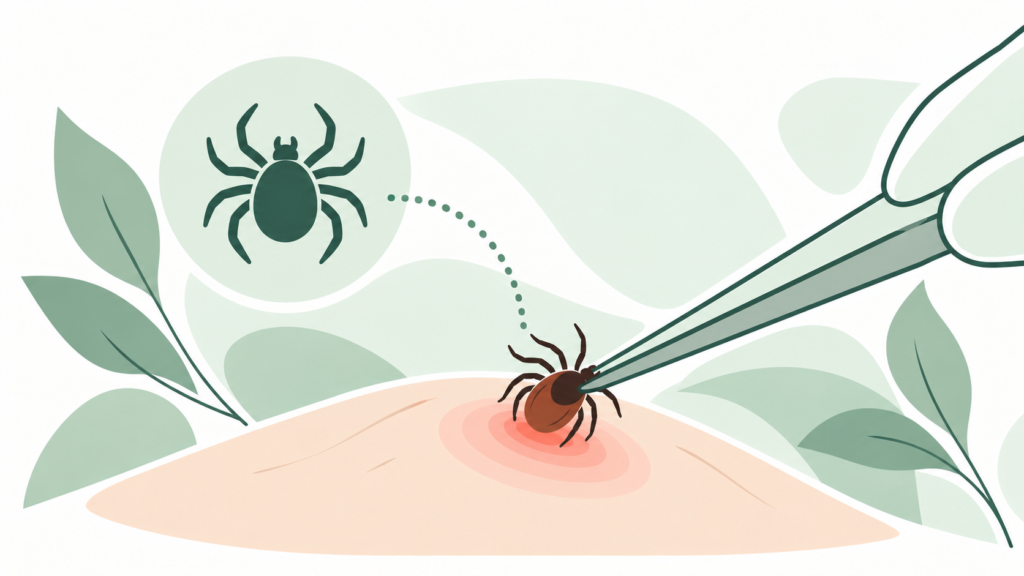
If you find a tick attached to your skin, remove it immediately using fine-tipped tweezers. Clean the bite area, check for additional ticks, and watch for symptoms over the next 30 days. Most tick bites do not cause Lyme disease, but certain bites require prompt medical attention. [1]
Affiliate disclosure: LymeSearch may earn a commission when readers buy products through some links on our website. Commissions do not determine how we describe the evidence for any supplement or test. Read our Affiliate Disclosure.
Knowing what to do after a tick bite can help reduce your risk of Lyme disease and other tick-borne illnesses. This guide explains how to remove a tick safely, recognize warning signs, determine when antibiotics may be necessary, and understand when to see a healthcare professional.
How do you remove a tick safely?
Remove an attached tick as soon as you discover it. The longer an infected tick remains attached, the greater the potential risk of transmitting certain infections. [1]
The CDC recommends using fine-tipped tweezers to remove ticks safely. Do not wait for the tick to detach naturally or delay removal until you can see a healthcare professional.
Follow these steps:
- Use fine-tipped tweezers. Choose tweezers that allow you to grasp the tick close to the skin.
- Grasp the tick near its mouthparts. Hold the tick as close to the skin’s surface as possible without squeezing its body.
- Pull upward with steady pressure. Avoid twisting or jerking the tick because its mouthparts may break off.
- Dispose of the tick safely. Place it in alcohol, seal it in a container, wrap it securely in tape, or flush it down the toilet.
- Clean the bite area. Wash your skin and hands with soap and water, rubbing alcohol, or hand sanitizer.
What if part of the tick remains in your skin?
Occasionally, a tick’s mouthparts remain embedded after removal. If you can easily remove them with clean tweezers, do so.
If the remaining pieces cannot be removed easily, leave them alone. The skin will usually push them out naturally as it heals. [1]
What should you avoid when removing a tick?
Do not use petroleum jelly, nail polish, heat, or a lit match to make a tick detach. These methods are not recommended and can delay proper removal.
What should you do after removing a tick?
After removing the tick, clean the affected area and check your body for additional ticks. Finding one attached tick does not mean it was the only one.
Pay particular attention to areas where ticks commonly attach, including the scalp, behind the ears, under the arms, behind the knees, around the waist, and near the groin.
Record the date of the bite
Write down when you discovered the tick, where it was attached, and where you may have encountered it.
This information can help a healthcare professional evaluate your risk if symptoms develop later.
Should you save the tick?
Saving the tick is optional. A clear photograph or preserved specimen may help identify the species.
Identification can be useful because different tick species carry different disease risks.
However, the CDC does not recommend relying on laboratory testing of removed ticks to determine whether a person needs treatment. [1]
A tick testing positive for Lyme disease bacteria does not prove that infection was transmitted. A negative result does not necessarily rule out exposure from another tick.
What does a normal tick bite look like?
A small red bump at the site of a tick bite is common and does not necessarily mean you have Lyme disease.
Mild redness, itching, or irritation may appear shortly after the tick is removed. This can occur because of a local reaction to the tick’s saliva.
A typical local reaction generally remains small and improves rather than expanding over several days.
An expanding rash is more concerning, especially if it develops alongside fever, headache, fatigue, or body aches.
If the redness continues spreading or you develop other symptoms, contact a healthcare professional.
What symptoms should you watch for after a tick bite?
Early Lyme disease symptoms usually appear between 3 and 30 days after the bite of an infected tick. [2]
Symptoms can resemble the flu, which may make Lyme disease difficult to recognize without a known tick exposure.
Common early symptoms include:
- An expanding skin rash
- Fever and chills
- Headache
- Fatigue
- Muscle aches
- Joint pain
- Swollen lymph nodes
Not everyone develops every symptom, and some people do not remember being bitten by a tick.
Ticks can also transmit illnesses other than Lyme disease, including anaplasmosis, babesiosis, and ehrlichiosis.
These infections may cause fever, chills, headache, fatigue, and muscle aches, sometimes without a rash.
Certain tick bites are also associated with alpha-gal syndrome, an allergy that can cause reactions to some mammalian products. [7]
If you become ill after possible tick exposure, tell your healthcare professional about the bite even if you never developed a rash.
Learn more about the infection in our complete guide to Lyme disease .
What does a Lyme disease rash look like?
The characteristic Lyme disease rash is called erythema migrans. It usually expands gradually over several days. [2]
The CDC reports that approximately 70 to 80 percent of infected people develop this rash.
Although Lyme disease is often associated with a bull’s-eye pattern, many rashes do not resemble a bull’s-eye.
Some appear as a uniformly red patch. On darker skin, the rash may appear bluish or resemble bruising.
The rash may feel warm but is usually not painful or itchy.
An expanding rash following possible tick exposure should be evaluated by a healthcare professional.
When should you see a doctor after a tick bite?
Contact a healthcare professional promptly if you develop an expanding rash, fever, or other concerning symptoms after a tick bite.
You should also seek medical advice quickly if the tick may have remained attached for an extended period, particularly in an area where Lyme disease is common.
Important warning signs include:
- An expanding rash
- Fever or chills
- Severe headache or neck stiffness
- New joint pain or swelling
- Facial weakness or drooping
- Numbness, tingling, or unexplained weakness
If preventive antibiotics are appropriate, treatment needs to begin within 72 hours of tick removal. [3]
Do you need antibiotics after a tick bite?
Most tick bites do not require antibiotics. However, preventive treatment may be recommended after certain high-risk bites.
The IDSA, AAN, and ACR clinical guidelines recommend considering preventive antibiotics when a tick bite meets specific criteria. [3]
These criteria help determine whether the risk of Lyme disease is high enough to justify preventive treatment.
| Criterion | Requirement |
|---|---|
| Tick species | An identified Ixodes tick capable of transmitting Lyme disease. |
| Geographic risk | The bite occurred in an area where Lyme disease is highly endemic. |
| Attachment duration | The tick was attached for at least 36 hours. |
| Treatment window | Preventive treatment can begin within 72 hours of tick removal. |
When these conditions are met, a healthcare professional may prescribe a single preventive dose of doxycycline.
The recommendation can apply to eligible adults and children, but a clinician must consider individual circumstances, including allergies, pregnancy, and other medical factors.
Preventive treatment is different from treating an established Lyme disease infection.
If Lyme disease develops, the appropriate antibiotic and treatment duration depend on the clinical findings. [4]
Should you get tested for Lyme disease after a tick bite?
Lyme disease blood testing is generally not recommended immediately after a tick bite when you have no symptoms.
Standard Lyme disease blood tests detect antibodies produced by the immune system in response to infection.
These antibodies take time to develop, so a test performed soon after exposure may be negative even when infection is present.
The CDC explains that antibody tests may produce false-negative results during the first four to six weeks after infection. [5]
If you develop symptoms, a healthcare professional can determine whether testing is appropriate.
In areas where Lyme disease is common, a characteristic erythema migrans rash may be diagnosed clinically without waiting for blood tests. [3]
How long after a tick bite can Lyme disease develop?
Early Lyme disease symptoms typically appear between 3 and 30 days after an infected tick bite. [2]
The expanding erythema migrans rash often develops during the first one to two weeks.
Without treatment, Lyme disease can spread beyond the initial bite area over days to months.
Later manifestations can include additional rashes, joint swelling, facial weakness, nerve pain, and heart rhythm abnormalities.
Early diagnosis and appropriate antibiotic treatment generally improve the likelihood of recovery.
For a complete explanation of Lyme disease symptoms, diagnosis, and treatment, read our pillar article: What Is Lyme Disease?
How can you prevent future tick bites?
Preventing tick bites is one of the most effective ways to reduce your risk of Lyme disease and other tick-borne illnesses.
The CDC recommends combining several protective measures when spending time outdoors. [6]
Important prevention steps include:
- Use EPA-registered insect repellents according to product instructions.
- Treat clothing and outdoor gear with products containing 0.5 percent permethrin. Do not apply clothing-treatment permethrin directly to your skin.
- Wear long sleeves, long pants, and closed shoes when appropriate.
- Stay near the center of trails and avoid brushing against tall grass and vegetation.
- Perform full-body tick checks after spending time outdoors.
- Shower within two hours of returning indoors when possible.
- Tumble-dry dry clothing on high heat for 10 minutes to kill ticks. Damp clothing may require additional time.
- Check pets, backpacks, and outdoor equipment for ticks.
No single measure eliminates every risk. Combining these precautions provides better protection.
Visit our Lyme disease prevention hub for more information.
Frequently asked questions
Can you get Lyme disease from a tick bite that lasts only a few hours?
The risk is generally very low when an infected blacklegged tick is removed within a few hours.
Transmission usually requires prolonged attachment, although the exact attachment time may be difficult to determine.
What if the tick’s head is still in my skin?
What appears to be the tick’s head is usually its remaining mouthparts.
Remove them with clean tweezers if they come out easily. Otherwise, allow the skin to heal.
Does every tick bite require antibiotics?
No. Most tick bites do not require preventive antibiotics.
Treatment is generally considered only when a bite meets established high-risk criteria.
Can Lyme disease develop without a rash?
Yes. Not everyone with Lyme disease develops or notices a rash.
Fever, headache, fatigue, muscle aches, and joint pain may also occur.
Should I see a doctor if I feel fine?
Not every tick bite requires a medical appointment.
However, contact a clinician promptly if the bite may qualify as high-risk, because preventive treatment must begin within 72 hours of removal.
How long should I watch for symptoms?
Watch for symptoms over the next 30 days, including an expanding rash, fever, headache, fatigue, or joint pain.
If symptoms develop later, tell your healthcare professional about your previous tick exposure.
The takeaway
If you discover an attached tick, remove it immediately using fine-tipped tweezers and steady upward pressure.
Clean the bite area, record when and where the bite happened, and monitor for symptoms over the following 30 days.
Most tick bites do not result in Lyme disease. However, an expanding rash, fever, or other concerning symptoms should prompt medical evaluation.
If you believe the bite may be high-risk, contact a healthcare professional within 72 hours of tick removal to discuss preventive treatment.
To understand how Lyme disease develops and how it is treated, read our parent pillar: What Is Lyme Disease? Symptoms, Causes, Diagnosis, and Treatment .
References
- CDC: What to Do After a Tick Bite
- CDC: Signs and Symptoms of Untreated Lyme Disease
- AAN/ACR/IDSA Guidelines for the Prevention, Diagnosis and Treatment of Lyme Disease
- CDC: Treatment and Intervention for Lyme Disease
- CDC: Clinical Testing and Diagnosis for Lyme Disease
- CDC: Preventing Tick Bites
- CDC: About Alpha-gal Syndrome